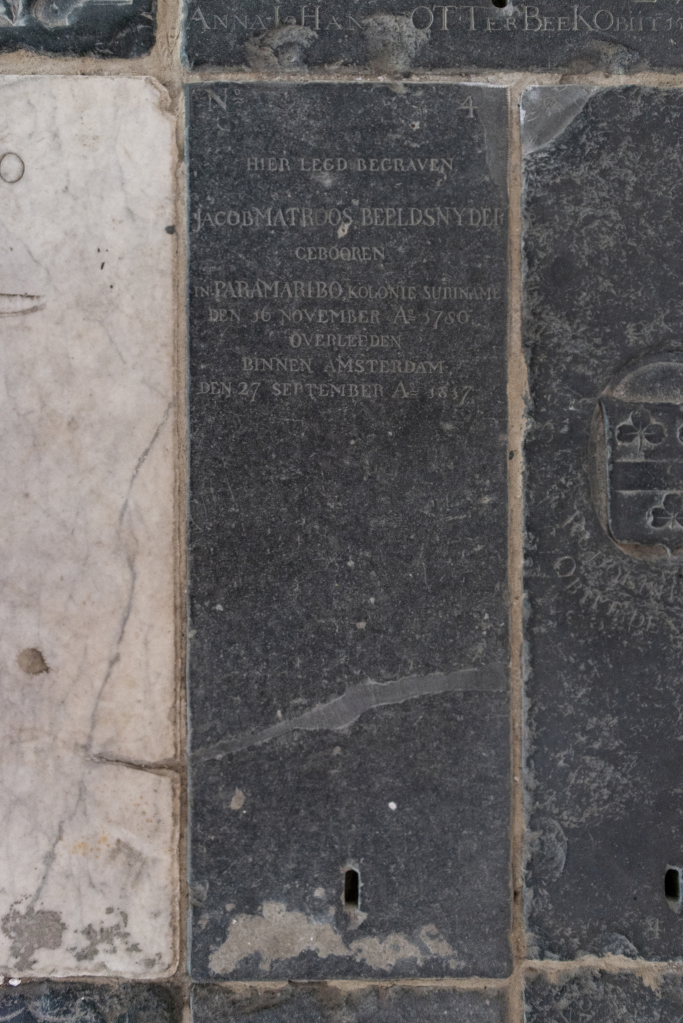
Mariakapel 41, Jacob Matroos Beeldsnijder

Arts and heritage
Burried under this stone was Jacob Matroos Beeldsnijder (1780-1817), an extraordinary person in (Dutch) history. He was the son of a Dutch father, Wolphert Beeldsnijder, and an Afro-Surinamese mother, Elizabeth “Betje” van Beeldsnijder. Betje was an enslaved woman. His father was a high official in Suriname and came from a patrician family with deep roots in the Dutch slavery economy. His grandfather, Jacob Baron de Petersen, played a key role in the West India Company (WIC), determining the fate of many enslaved people along the Ghanaian coast. [Jacob Baron de Petersen](https://oa.sharebox.nl/collect/4704-107?lang=en), like his great-grandchild Jacob Matroos Beeldsnijder, was buried in the Oude Kerk. --- ## A life in Suriname and Amsterdam At birth, Jacob and his twin brother Ernst, like their mother, were owned by their father. In 1781, however, Betje and her sons were bought free by Wolphert, and the brothers grew up in an elite environment in Suriname. Until 1789, the year Jacob and Ernst left for Amsterdam to attend school. At age 17, the brothers returned to Suriname. Jacob worked in Paramaribo as a clerk for a Dutch trading company. This brought him financial success; in fact, in 1816 he owned a house and a riding horse in Paramaribo. He also worked as a poet and his life was dominated by literature and poetry. Although his background and upbringing gave him a certain status, Jacob's life in both Holland and Suriname was marked by prejudice. ## The only person of color in the Oude Kerk Due to health problems, including gout and chronic abdominal pain, Jacob Matroos Beeldsnijder decided to return to Holland in 1817. He hoped to be cured here, but died just three weeks after his arrival, on Sept. 3, 1817. His half-sister Majorin Bijval purchased a grave in the Old Church for him. Jacob left behind his beloved Lucia van Walraven and several children. Additionally, the life of Jacob Matroos Beeldsnijder to this day is a story that represents not only the layered history of the Oude Kerk, but also the broader history of the African diaspora and Suriname's colonial legacy. His story can be a point of reference for people, who may not be comfortable with the local history of the church. So too for Ibrahim Mahama, who, among other things, took the grave of Jacob Matroos Beeldsnijder as a starting point for his research and exhibition (2022) at the Oude Kerk.